Bus Simulator : 3D Bus Games
- 4.7
- Rating
- 50.00M
- Installs
- Free
- Price
 Analysis by App-foxy
I spent time with Bus Simulator: 3D Bus Games expecting a straightforward driving game, and that is exactly where it works best. It puts me behind the wheel of a bus and focuses on the practical side of getting through routes, completing driving missions, and parking a large vehicle without turning every session into a complicated management exercise. That narrow focus makes it easy to understand, but it also means the experience depends heavily on whether you enjoy careful, repetitive driving.
GamePark presents it as a simulation game, and I think that description is fair. This is not an arcade racer where the fastest player automatically wins. The appeal comes from controlling a bulky bus, judging turns, approaching stops or parking areas carefully, and trying to finish a task without making careless mistakes. I found the best moments came when I slowed down and treated each maneuver as a small driving puzzle rather than rushing from one checkpoint to the next.
The game is free to install and play, which gives it an obvious advantage for anyone who wants to test the idea without committing money first. It is marked for Teen players, runs on Android 7.0 or later, and the current version is 4.0.3. Those details make it accessible to many older Android devices, although a compatible operating system does not automatically guarantee equally smooth performance on every phone.
You May Also Like

 Blood Strike: 2.5 Anniversary
Blood Strike’s Loadouts Turn Every Drop Into a Tactical Gamble
A close look at Blood Strike’s custom loadouts: how fast access to signature weapons reshapes its battle royale rhythm, rewards preparation, and narrows the gap between fights.

 Pandora - Music & Podcasts
Pandora’s Music Is Easy to Start, but Harder to Recover
Pandora’s strength is its low-effort path from a seed to a station. Its weak spot is how much confidence it asks you to place in connection, setup, and quiet recovery.

 8 Ball Pool
 Is Built on Rivalries, Rematches, and Routine
A close look at the rivalries, rematches, shared routines, and unanswered safety questions that turn a quick pool match into a persistent mobile community.

 Samsung Music
’s Quiet Strength Is Playing What You Already Own
Its reach comes less from spectacle than from dependable access to a personal library. That simplicity is both the app’s strongest retention engine and its ceiling.

 AccuWeather: Weather Radar
AccuWeather Review: A Quick, Clear Forecast for Everyday Decisions
For everyday plans, the best forecast is the one you can understand quickly. AccuWeather makes rain timing, radar, and local conditions easy to act on, with a few trade-offs.

 Hill Climb Racing
Why Hill Climb Racing Still Turns Crashes Into One More Run
A tiny car, a bumpy hill and one more upgrade: Hill Climb Racing keeps resurfacing because its simple chaos makes every near-miss feel personal.
More From Our News Desk
View All News


How the driving, missions, and parking come together
I find the appeal of Bus Simulator: 3D Bus Games clearest when I treat each mission as a sequence: set up the approach, manage the turn, then make the parking adjustment. That way, a rough attempt tells me which part needs work instead of making the whole drive feel like a failure. This practical rhythm also makes it easier to judge whether the game’s focused challenges are the kind of progress I want.
A simple starting point for bus-driving fans
The first thing I noticed is how quickly the central idea becomes clear. You are not asked to learn a long list of systems before driving. The game is built around bus movement, mission objectives, and parking challenges, so a new player can understand the purpose of a session almost immediately. That simplicity is useful when I only have a few minutes and want something more deliberate than a typical racing game.
Driving a bus feels different from steering a small car in a mobile game. The vehicle occupies more space, and a turn that looks harmless from the front can become awkward when the rear follows a wider path. I learned to begin turning later than I would in a car game and to leave extra room near corners. That is a small adjustment, but it changes the experience from random swerving into something that feels intentional.
The parking missions are especially good for learning that habit. They reward patience more than speed, and I found myself using short corrections instead of holding a direction continuously. If the bus starts drifting toward an obstacle or the edge of a parking area, a gentle correction is usually easier to recover from than a dramatic steering movement. New players should resist the temptation to force the vehicle into place in one attempt.
Why the mission structure matters
The driving missions give the game a clear reason to keep playing. Instead of wandering without a goal, I usually had a specific task to complete. That structure suits players who like short, self-contained challenges. It also makes the game easier to pick up after a break because the basic objective remains understandable even when I have not played for several days.
At the same time, the mission format can feel repetitive if you want a deep transport simulation. The core actions remain centered on driving and parking, so the experience does not offer the same breadth as a more elaborate simulator built around timetables, route planning, passenger management, or a large open map. I would choose this title for focused vehicle handling, not for running a detailed bus company.
That distinction is important when comparing it with usual alternatives in the simulation category. A racing game is better if your priority is speed, overtaking, and competition. A larger transport simulator is a better fit if you want to manage routes and make long journeys. This game sits between those extremes: it gives driving a more careful, task-based feel without requiring the time or attention of a full management simulation.
Controls reward restraint
My most useful adjustment was to stop treating the controls like an arcade steering wheel. Bus movement becomes easier when I make small inputs, release them early, and let the vehicle settle before making the next correction. This matters most during parking, where oversteering can turn a manageable approach into a series of unnecessary reversals.
I also found it helpful to think about the rear of the bus rather than only watching the front. The front may clear a corner while the back swings toward a boundary. Keeping that wider movement in mind is one of the few techniques that consistently improved my results. It is a practical lesson that the store summary does not explain, and it makes the missions feel more satisfying once it becomes second nature.
Another useful routine is to separate the drive into phases. I approach the area slowly, line up the bus before turning, and only then make the final parking correction. Trying to combine all three steps at once usually creates more work. Players who are struggling should not immediately blame the controls; changing the order of their movements can make a bigger difference than driving faster.
What the presentation does well and where it falls short
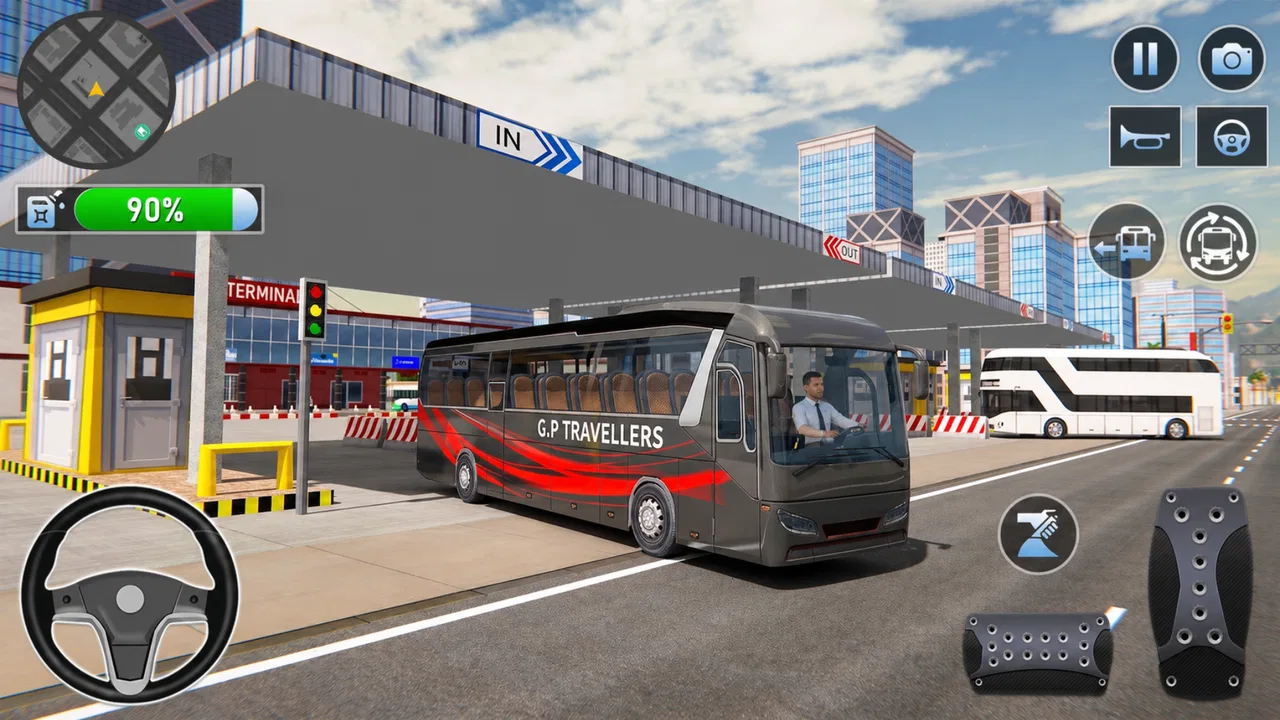
The 3D presentation supports the basic idea by making space and positioning important. I can judge the bus in relation to the road and parking area, which is essential for a game built around large-vehicle maneuvering. The visual approach is functional rather than the main attraction, so I would not come here expecting a showcase of mobile graphics.
That is not necessarily a problem. A lighter, more direct presentation can be useful on a phone because it keeps attention on the task. However, players who want highly detailed environments, a strong sense of travel, or a cinematic driving atmosphere may find the world less compelling than the vehicle handling itself. The game’s value comes from interaction, not from presenting an elaborate sightseeing experience.
Sound and visual feedback also matter more in a parking-focused game than they might in a casual racer. Clear feedback helps me understand whether a maneuver is going well, while weak feedback makes mistakes feel arbitrary. I recommend playing the early missions as practice rather than trying to rush through them. They are the best place to learn how the bus responds before the parking challenges become more demanding.
The practical cost of trying it
The financial decision is simple: the game is free. That means I can install it, test the driving feel, and decide whether the mission loop suits me without paying an entry price. For a niche interest such as bus driving, free access is meaningful because the main question is personal taste. Some people enjoy careful parking immediately; others discover that the same precision becomes tiring after a short session.
I would describe the value as low-risk access rather than guaranteed long-term value. A free game can still demand time, storage, attention, or patience, and this one is most worthwhile when its focused style matches what you want. I would not judge it by the standards of a paid premium simulator with a broader feature set, because the two products are making different promises.
There is also a useful difference between “free to try” and “valuable to everyone.” The absence of an upfront price makes experimentation easy, but it does not remove the tradeoff of repetition. If you enjoy mastering vehicle positioning, the free access gives you a convenient practice game. If you need constant variety, a free download alone will not make the mission structure feel fresh.
Everyday situations where it fits
I think this game works particularly well during short waiting periods. If I have enough time for a few focused attempts but not enough time for a long story or a complete online match, a parking mission gives me a clear beginning and end. The concentration required also makes it more engaging than simply tapping through an idle simulation.
It can be a good choice for someone who is curious about bus driving but does not want the complexity of a full transport-management game. A player can practice turning, spacing, and controlled parking without first learning a large economy or route system. That makes it approachable for casual simulation fans, younger players within the Teen rating, and anyone who likes vehicle challenges with visible objectives.
On the other hand, I would skip it if my ideal bus game involves passengers reacting to service quality, realistic schedules, extensive customization, or long-distance exploration. The focused mission design is also less suitable for players who dislike repeating similar driving actions. In that case, a broader simulator or a conventional racing game would probably provide better value, even if it required a different purchase decision.
Audience, compatibility, and expectations
The game has reached over 50 million installs and holds an average rating of 4.6 from around 131 thousand ratings, which suggests that its straightforward bus-driving concept has found a substantial audience. I treat those figures as a sign that the basic loop is appealing to many players, not as proof that every device or every play style will suit it.
It is developed by GamePark and was released on July 6, 2019. The long availability gives it the feel of an established mobile title rather than a brand-new experiment. The current version, 4.0.3, is the one I would look for when checking whether my device is ready to run it. Since the minimum Android requirement is 7.0, owners of older phones should check their operating system before expecting to install it.
The Teen content rating is another point parents and younger players should notice. It does not change the driving focus, but it is still part of deciding whether the game fits a particular household. I would also recommend checking how comfortably the game runs on the specific phone being used, especially if it is an older model. The minimum operating system tells me about compatibility at a basic level, not about the quality of every possible hardware experience.
Small techniques that improve the experience
My first tip is to use the road width as a planning tool. Rather than waiting until the bus is already beside a corner, I begin positioning before the turn. This reduces the need for sharp steering and gives the rear of the vehicle more room. It is particularly useful when a mission places the bus close to boundaries, because late corrections tend to be exaggerated.
My second tip is to treat reversing as a controlled sequence, not a single action. I make a small movement, check the angle, and then adjust. This takes longer than holding the control continuously, but it prevents the common mistake of correcting one problem while creating another at the opposite end of the bus. Players who are new to vehicle simulators may find this slower rhythm surprisingly effective.
My third tip is to replay a difficult task with one goal at a time. On the first attempt, I focus on learning the route and the space. On the next, I work on a cleaner turn or a better parking angle. Trying to achieve perfect movement immediately can make the game frustrating, while breaking the challenge into parts turns failure into useful practice.
A fourth insight is that the game is better used as a precision exercise than as a background activity. It demands enough attention that playing while distracted can make even simple maneuvers feel unfair. When I give it a few uninterrupted minutes, the controls feel more predictable. When I play casually while doing something else, the same mission becomes much less enjoyable.
Where the tradeoffs become clear
The biggest limitation is the narrowness of the central loop. Driving and parking are the reason to play, but they are also the source of repetition. There is no point in pretending that a focused bus simulator will satisfy someone looking for a broad collection of unrelated activities. Its strength is clarity, and its weakness is that clarity leaves less room for surprise.
Another tradeoff is between accessibility and depth. The game is easy to understand because it does not bury the player under complicated systems. That makes it friendly to newcomers, but experienced simulation fans may want more layers after they master the basic handling. If you prefer learning a detailed vehicle model over many sessions, you may eventually outgrow this simpler approach.
The free price also changes how I evaluate it. I can recommend trying it without asking a reader to risk money, but I would still be honest about the time commitment involved in mastering parking missions. Free access is strongest here for curious players and short-session users. It is less persuasive for someone who already knows they want a premium, feature-rich transport simulation.
My recommendation after playing
I would recommend Bus Simulator: 3D Bus Games to players who want a free, direct way to practice bus driving and parking on Android. The game communicates its purpose quickly, gives missions a clear structure, and makes careful steering more rewarding than frantic movement. It is especially suitable for short sessions, beginners who want an approachable simulation, and anyone who enjoys improving through repeated attempts.
I would not recommend choosing it solely because it is popular or because the word “simulator” suggests a complete transport-management experience. Its appeal is more specific. If you want detailed route planning, a large travel environment, or a deeper bus-operation system, look for an alternative built around those features instead. If you want a focused driving challenge, this one is easier to justify.
My final view is that the free entry point gives it genuine practical value, provided you understand the tradeoff. You are getting an accessible bus-driving game centered on missions and parking, not a full replacement for every kind of simulation. For me, that focused design is enough to make it worth trying, and the best reason to keep it installed is the satisfying improvement that comes from learning to place a large bus accurately.
Verdict: download it if controlled driving, parking practice, and short mission-based sessions sound enjoyable. Skip it if repetition bothers you or if your idea of a bus simulator depends on management, long journeys, or extensive customization. The cost of trying is low because access is free, while the real decision is whether the careful driving loop holds your attention.
FAQs for Bus Simulator : 3D Bus Games
01What are the main features of Bus Simulator: 3D Bus Games?
Bus Simulator: 3D Bus Games offers an immersive experience with realistic 3D graphics and detailed environments. Players can explore various routes and locations while driving a wide range of buses. The game includes dynamic weather conditions, day-night cycles, and traffic systems, enhancing the overall realism and challenge.
02Is Bus Simulator: 3D Bus Games free to play?
Yes, Bus Simulator: 3D Bus Games is free to download and play. However, it may contain in-app purchases that allow players to unlock additional features, buses, or customization options. These purchases are optional and not necessary to enjoy the main gameplay experience.
03Can I play Bus Simulator: 3D Bus Games offline?
Bus Simulator: 3D Bus Games supports offline play, allowing users to enjoy the game without an internet connection. However, certain features like online leaderboards or updates may require an internet connection to function properly. Check the app's settings for more information on offline capabilities.
04What devices are compatible with Bus Simulator: 3D Bus Games?
The game is available on both Android and iOS platforms. It requires a device running at least Android 5.0 or iOS 10.0. To ensure optimal performance, make sure your device meets the minimum hardware requirements, such as sufficient RAM and processing power.
05Are there any age restrictions for Bus Simulator: 3D Bus Games?
Bus Simulator: 3D Bus Games is rated for users aged 3 and above, making it suitable for a wide audience. However, parents should be aware that the game includes in-app purchases, and they may want to monitor their children's spending or set up parental controls to manage access.
Pros
- Realistic driving physics enhance gameplay.
- Wide variety of buses to choose from.
- Detailed city maps add to immersion.
- Intuitive controls for easy navigation.
- Regular updates with new content.
Cons
- Occasional in-game ads may disrupt play.
- Some graphics could be more detailed.
- Limited customization options for buses.
- Requires stable internet for best performance.
- Minor bugs reported by some users.

Bus Simulator : 3D Bus Games
Gallery